

The hidden cost for roll-out

“What? Funkis has its own tool for developing digital learning? I’ve never heard of that before—can you even do that?”

This was the question from the head of training at a well-known Swedish organization, right as we were pitching for a big digital education project. I was caught off guard, unsure if I’d missed something obvious. It was clear we had different experiences, and I hadn’t realized just how widespread authoring tools had become recently.

After 20 years in the learning business, one thing still puzzles me:

Why is it so hard to talk about the total cost of a learning solution?

We’ve participated in countless RFPs, where we presented solutions that could drastically cut roll-out costs—especially for large audiences. But it often feels like we’re speaking a foreign language.

The people we talk to usually have a clear, limited budget. Often, they’re responsible for buying training – not for what happens after. And the business stakeholders? They have their own numbers to worry about.

The result is a kind of tunnel vision: decisions are made based on what’s easy to measure today, not what actually saves money in the long run.

And despite all the talk of innovation, much of the training industry still operates like it did 15 years ago.

Two types of costs – one big blind spot

One of the main reasons is how budgets are structured.

Training costs are typically split in two:

  • Development – the cost of creating the content or program
  • Roll-out – the cost of delivering it, often repeatedly


Here’s the catch: these two costs often sit in completely different budget silos. One department might pay to create the training. Another pays to deliver it. That makes it very hard to get a complete picture.

And more often than not, the majority of the money goes to roll-out.

The real cost is in the delivery

According to Training Magazine’s U.S. 2024 Training Industry Report, around 61% of total training spend goes to staff payroll – the people who deliver and manage training.

When you add travel, materials, room bookings and other logistics, it becomes clear: most of the budget is consumed before you’ve even addressed the question of learning effectiveness.

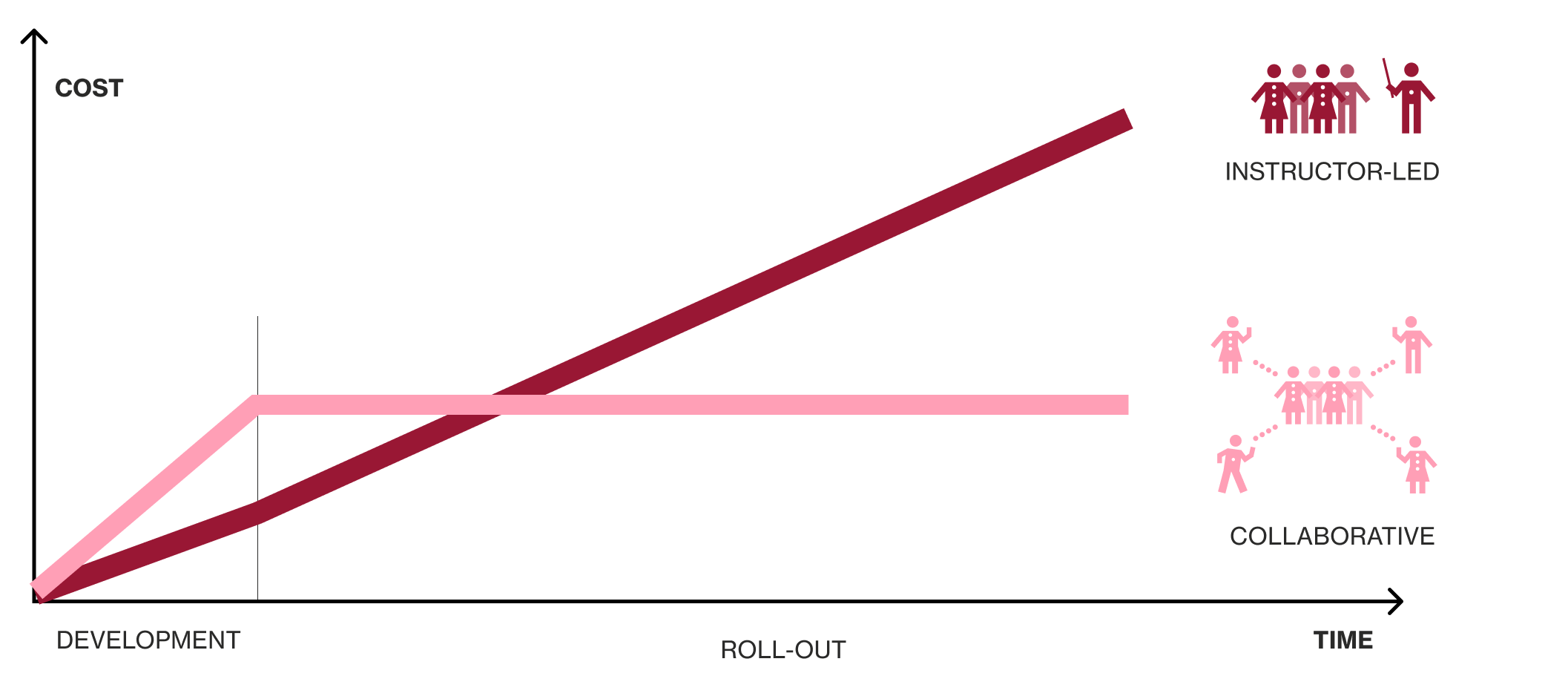
Development of an instructor-led training may feel cheap – but that’s misleading

Let’s say your team creates a PowerPoint-based workshop in-house over 50–60 hours. That might seem like a bargain – low effort, low cost.

But here’s the trap: if the program is designed for instructor-led delivery, and you need to run it repeatedly, the delivery costs scale with every new group. And they scale fast.

What does roll-out actually cost?

Let’s put some numbers to it.

According to Eurostat’s 2022 report, the average direct cost of delivering training in Europe is 64 EUR per participant, per hour.

For a full-day course (8 hours), that equals:

512 EUR per person

If you train:

  • 100 people → 51,200 EUR

  • 1,000 people → 512,000 EUR

And that’s only the direct financial cost. There are also indirect costs, such as lost productivity or salary costs for participants who are absent from their regular work during the training period. And the issue of capacity.

Instructor-led training often requires internal facilitators to be trained first – which can be time-consuming, costly, and logistically difficult. In our experience, it’s not uncommon for roll-out to stall simply because the organisation runs out of available trainers.

The demand is there – but the delivery model can’t keep up.

Now imagine flipping that model

What if you invested more in development upfront – and in return, got low-cost, scalable delivery?

It would completely change the economics of training.

Total cost would go down significantly over time.


This is what we do – and why it works

Our collaborative learning programs are designed to do exactly this.

They combine strong instructional design, engaging team formats and scalable delivery to help organisations reduce costs while improving outcomes.

In the example above:

Instead of spending over half a million euros on traditional delivery, we can develop and roll out an equivalent, high-quality program for 100,000 EUR – without losing the human element.

More than just cost savings

This approach doesn’t only save money.

It brings other strategic benefits:

  • Consistency across teams and locations
  • On-demand access and flexible timing
  • Valuable data to support learning analytics and talent development

So… why is it so hard to think holistically?

When savings like these are clearly within reach, the question remains:

Why is it so difficult to include the total cost in the decision-making process?

Perhaps the answer is tradition. Or habit. Or silos.

But maybe it’s time to shift the conversation.